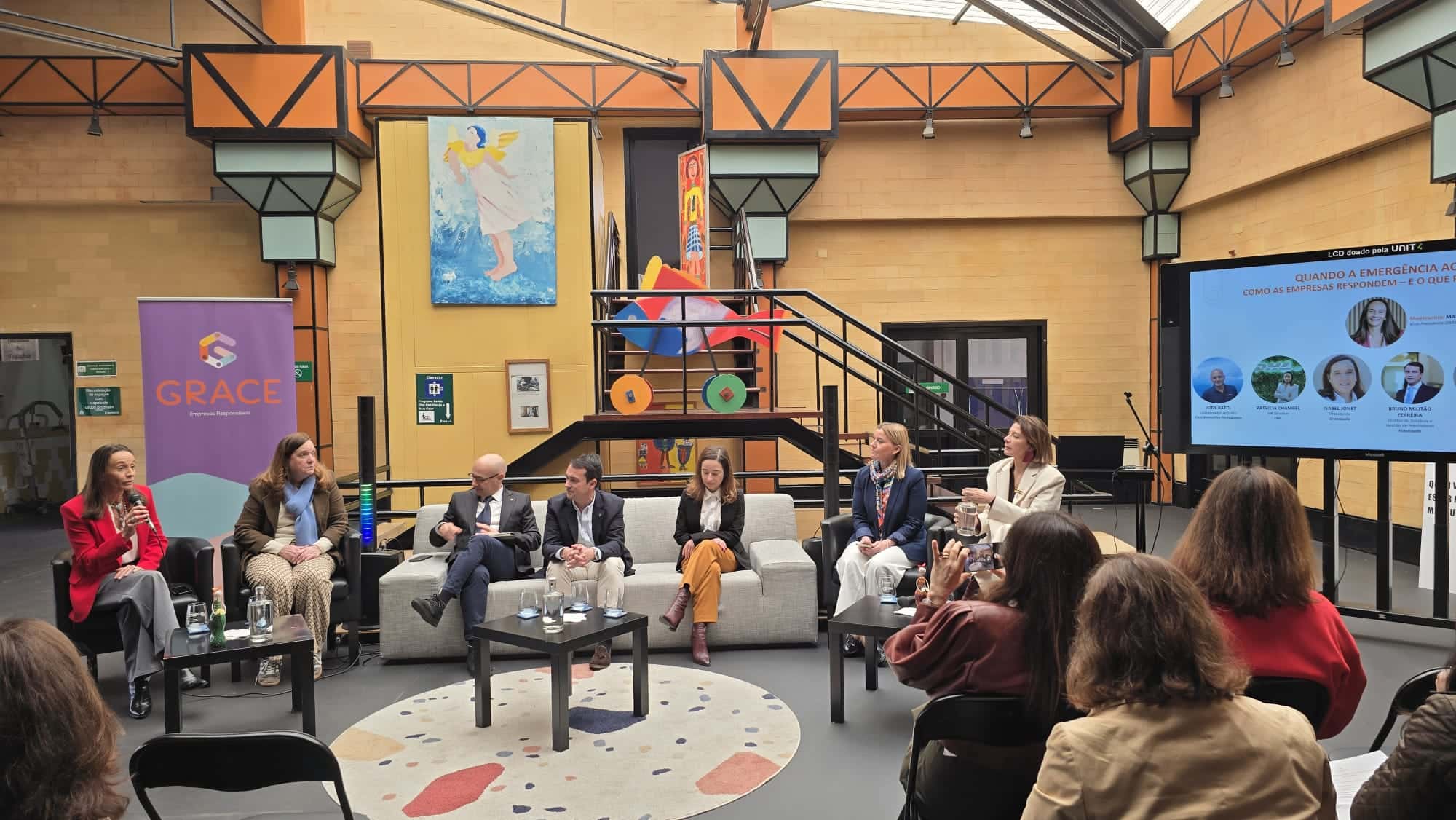
Companies, social sector and authorities discuss collective response to disasters and emergencies
The growing frequency of extreme phenomena and the impact they have on communities require increasingly coordinated responses between public institutions, civil society organizations and companies. This was the starting point of the meeting "Disasters and Emergencies: from institutional response to collective action by companies"promoted by GRACE - Responsible CompaniesThe event brought together different organizations to reflect on the role of collaboration in responding to crisis situations.
The event took place at the premises of the LIGA Foundation, to whom we would like to thank for their availability and hospitality, which made this initiative possible.
At the opening session, Maria João Simões de AlmeidaIn his speech, GRACE highlighted the fact that the effects of extreme events are being felt more and more visibly in the territory, reinforcing the need for collective mobilization. In this context, we also reinforced GRACE's role as a platform for linking organizations, capable of facilitating the connection between companies and entities on the ground when urgent needs arise in communities.
Culture of prevention and organized response
One of the central themes of the meeting was the importance of preparedness and a culture of prevention. Pedro CarvalhoThe head of the National Emergency and Civil Protection Authority (ANEPC) explained that the civil protection system in Portugal is based on a progressive response logic, which starts at local level and can escalate to regional or national structures when the scale of the emergency requires it.
According to the official, the response to emergencies begins with the citizens themselves, by promoting a culture of safety and individual resilience. "Preparedness should be worked on from an early age, in contexts such as schools or workplaces," he said.
From solidarity to effective resource management
Resource management in emergency contexts was another of the topics covered. Nélson Antunes, representing the Mission Structure, presented the experience of the structure created after an emergency situation that affected several areas in the central region of the country, where the destruction of homes and businesses was accompanied by interruptions in the supply of essential services such as energy and water.
Among the solutions developed was the creation of a digital crowdfunding platform to support reconstruction projects presented by local communities. The experience also revealed a frequent challenge in crisis situations: despite the strong mobilization of solidarity, many of the goods donated did not correspond to the most urgent needs on the ground, which reinforces the importance of centralized management of needs.
Companies and organizations mobilize resources
The round table, moderated by Mariana Ribeiro FerreiraGRACE's Vice-President, representing CUF, brought together representatives of social organizations and companies who shared different experiences of mobilization in crisis contexts.
Isabel JonetShe presented the Emergency Solidarity Network, created to coordinate support responses in emergency situations. She warned of the importance of ensuring transparency in the management of funds and avoiding hasty responses, pointing out that it is essential to first understand what the real needs are on the ground.
Jody Rato, of the Portuguese Red Cross, explained that the organization's actions vary between predictable scenarios - such as certain storms - and unexpected situations, in which the response has to be built up progressively in conjunction with the civil protection authorities.
On the business side, examples of emergency plans and crisis response mechanisms were presented.
At Fidelidade, represented by João Militão FerreiraThe emergency plan includes activating helplines for affected customers and sending teams of experts to assess the damage on the ground. The communication area also plays a central role in defining internal and external guidelines, in a sector that is particularly exposed from a communication point of view, where clear and coordinated communication is essential. Patrícia ChambelDHL highlighted the existence of specialized disaster response teams, capable of providing logistical or operational support when requested by the authorities, namely by making its transport capacity available to the authorities to get the necessary aid to the affected areas. Also Sofia Miranda of the Couples Group and Rita DinisThe MC Sonae team presented examples of internal crisis management plans, which involve different areas of the organizations and seek to guarantee a structured response in emergency situations.
The tourism sector was represented by the HEART program - Hospitality Environmental and Responsible Tourism, of the Hotel Association of Portugal, represented by Joana Castro Caldaswhich mobilizes hotels for social and environmental responsibility initiatives and has been activated in different emergency contexts, from the 2017 fires to the pandemic. The example of the "Tourism Welcomes" program was highlighted, in which 125 accommodation establishments have joined and made 1,000 more accommodation units available to the victims of the storms and the workers deployed for reconstruction - a clear example of how to put installed capacity at the service of the emergency.
Strengthening collaborative networks
During the meeting, we also shared examples of recent mobilization of our network of associates to support communities affected by storms. We acted as facilitators of collaboration between companies and entities on the ground, such as civil protection and the Red Cross, enabling us to identify specific needs and mobilize appropriate responses.
In this context, we announced the creation of the Community + CitizenshipThe aim is to strengthen the sharing of information, resources and good practices between member companies, promoting more agile communication and new opportunities for collaboration.
At the end of the session, the idea was reinforced that preparation and coordination between different sectors are decisive factors in improving the ability to respond to crisis situations. In a context of increasingly complex risks, we believe that collaboration between authorities, companies and social organizations will be increasingly decisive in ensuring faster, more effective responses in line with the needs of communities.




